
myfplcoach Guides
How to Plan Your FPL Gameweek in 5 Minutes with My FPL Coach
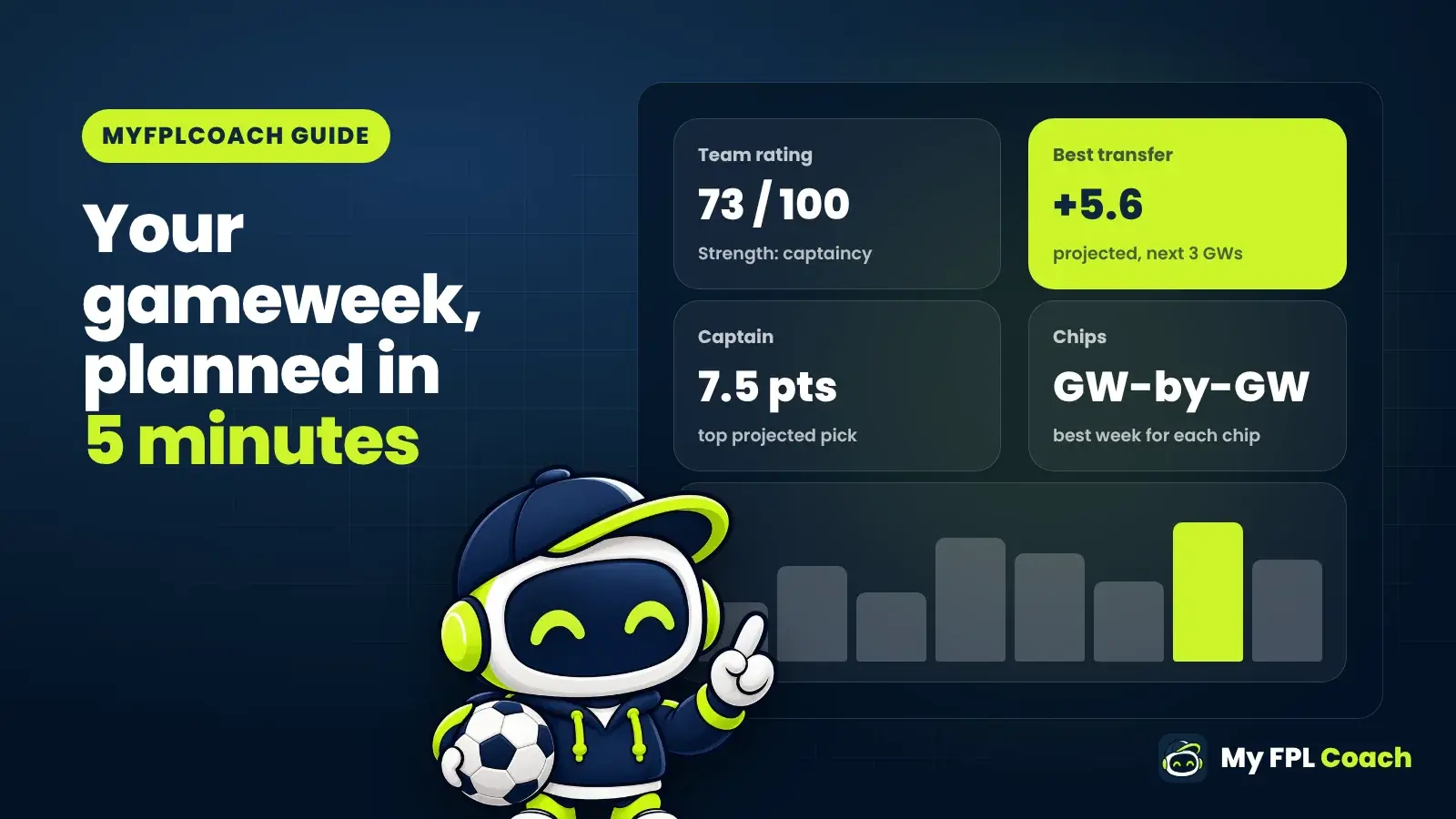
From Team ID to a finished plan: rate your squad, test transfers, pick a captain and time your chips, step by step.
My FPL Coach Editorial3 min read
Tips
Short, practical explanations of the decisions My FPL Coach helps you make. 7 guides, about 13 minutes in total.
From Team ID to a finished plan: rate your squad, test transfers, pick a captain and time your chips, step by step.
My FPL Coach Editorial3 min read
Sign in to the fantasy game and open Points. The address ends …/entry/1234567/event/7, and that number is your Team ID.
It is public, so anyone can view your squad with it, but nobody can change your team with it. You never need your password here.
In short: Your Team ID is read-only. Share it freely, but never share your password.
Rate your teamA banked transfer is worth something: next week you can make two moves, or fix an injury without a hit. You can hold up to five.
Rolling beats a marginal move. If the best swap is worth well under a point over the coming weeks, keep the flexibility. My FPL Coach puts a points value on rolling and only recommends a transfer that beats it.
In short: If the best move barely adds a point, roll it.
Test your transfersEach extra transfer costs 4 points, now. The gain is spread over future gameweeks and is uncertain, so a hit needs a clear margin: usually several points across the next few weeks, not just next week.
The best hits replace a player who won't play with one who will, or take advantage of a double gameweek.
In short: Take a hit only when the net gain is clear over several gameweeks.
See the net figureEffective ownership (EO) is ownership plus captaincy: a player 70% owned and captained by 40% has 110% EO.
If you own a player whose EO is above 100% but don't captain him, his haul can cost you rank even while you gain points. EO is a community measure, not an official figure.
In short: Above 100% EO, not captaining a player is itself a risk.
Compare with a rivalThe game's own 1–5 difficulty is a fixed opinion of each opponent. My FPL Coach rates every fixture by how many goals each side is likely to score and concede.
Use the attacking view for attackers and the clean-sheet view for defenders, and look at runs of three to five gameweeks rather than one.
In short: Judge runs of fixtures, and use the right view for each position.
Open fixture difficultySince 2025/26, defenders earn 2 points for 10 clearances, blocks, interceptions and tackles in a match. Midfielders and forwards need 12, and ball recoveries also count for them. It's capped at 2 points per match.
Busy centre-backs and holding midfielders gain the most, and My FPL Coach projects each player's chance of reaching the threshold every match.
In short: Consistent defensive work can be worth as much as an attacking return.
Compare playersStart with projected points, then weigh certainty against upside. A safer pick has secure minutes and a high floor; an aggressive pick has a higher ceiling and lower ownership.
When protecting a lead, captaining the popular choice limits your risk. When chasing, a strong differential captain is the fastest way to close a gap.
In short: Protecting a lead: go with the crowd. Chasing: back a strong differential.
Pick your captain