The short answer: fixture difficulty tells you how hard each upcoming match is, usually on a 1–5 scale. Use it to compare runs of three to six fixtures rather than single games, judge attackers by how many goals their opponents concede and defenders by how many their opponents score, and never let fixtures outweigh minutes.
Most FPL managers look at fixtures. Fewer use them well. The colour grid makes it easy to buy the team with one green fixture next week and forget that the following four are all red. This guide covers how the rating works, how to read a run of games, and the situations where fixtures matter less than they seem.
What fixture difficulty measures
The official game gives every fixture a Fixture Difficulty Rating (FDR) from 1 to 5. A 1 or 2 is an easy match, a 3 is average and a 4 or 5 is hard. The Premier League's FPL glossary covers FDR alongside other common terms.
A single number per fixture is a useful shortcut, but it hides two things:
- Attack and defence aren't the same. Some teams defend well but create little; others score freely and concede freely. A side can be a good fixture for your defender and a poor one for your forward.
- It changes slowly. A rating set from reputation can lag behind a team whose form has changed sharply.
That's why My FPL Coach rates each fixture by how many goals each side is likely to score and concede, and shows attacking and clean-sheet views separately in the fixture planner.
Read runs, not single games
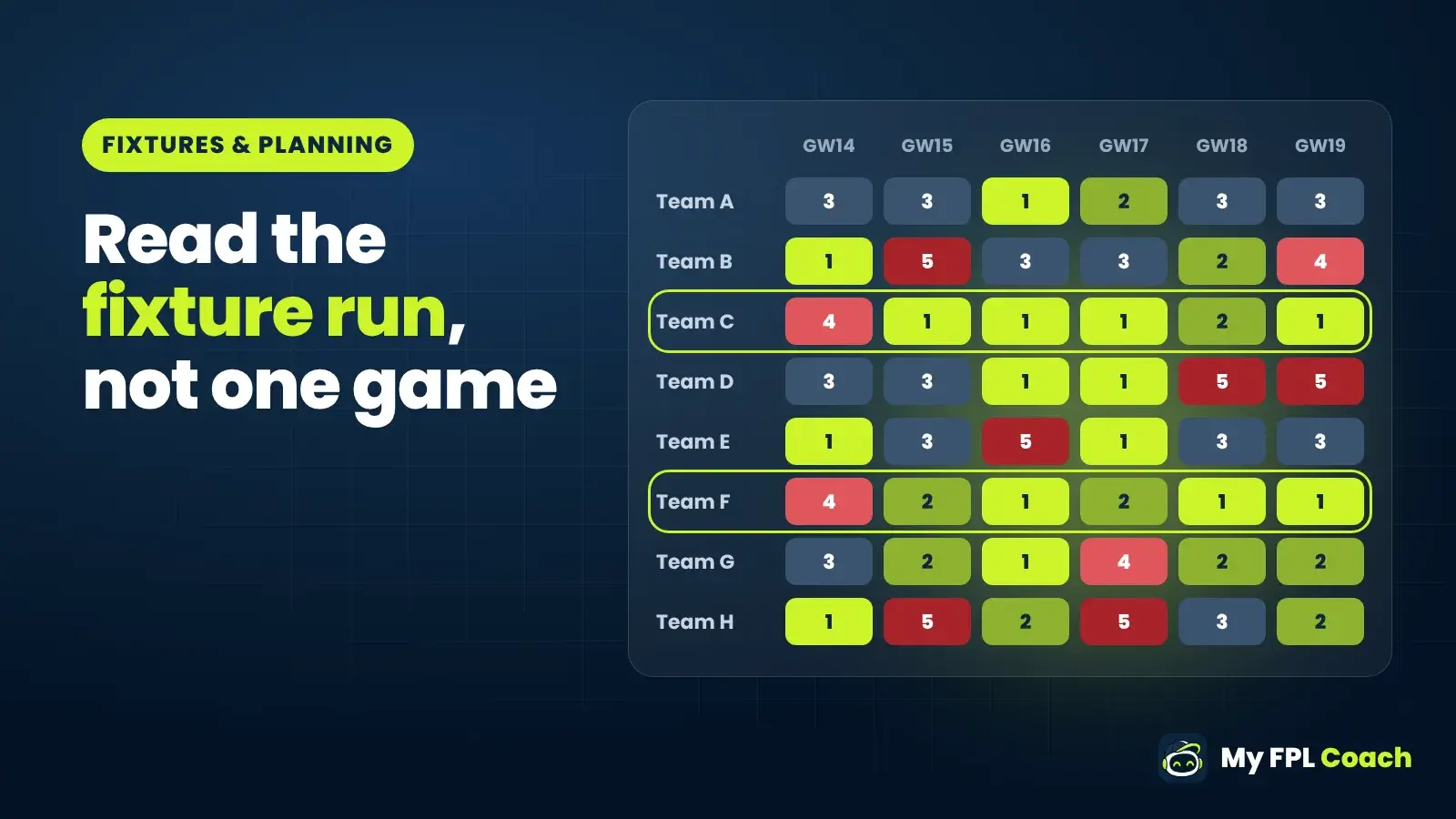
One easy fixture is worth a little. Four in a row are worth a lot, because they add up and because you're likely to keep the player for all of them. When comparing two players, add up the outlook over the next few gameweeks rather than looking at next week alone.
| Team | Next match | Next 5 matches | Verdict |
|---|---|---|---|
| Team A | Easy (1) | 1, 5, 4, 4, 5 | One good week, then a tough run |
| Team B | Hard (4) | 4, 1, 1, 2, 1 | Buy now, ready for the swing |
| Team C | Average (3) | 3, 3, 2, 3, 3 | Steady; fine for players who always start |
Example ratings for illustration only.
Team B is the classic "fixture swing". Buying its players a week early means one tough match but four kind ones, and you've got ahead of the managers who wait for the colours to change.
How far ahead to look
Three to six gameweeks is the practical range. Shorter, and you'll keep making transfers to chase single fixtures. Longer, and injuries, form and price changes make the picture unreliable. In My FPL Coach you can set the planning window to this gameweek, 3, 5, 8, 10 or any number up to 20, and every projection recalculates.
Attackers and defenders need different views
For defenders and goalkeepers, the question is how likely a clean sheet is. That depends on how many goals the opponent tends to score, and on your team's own defence. Defensive contributions add another angle: a defender facing a team that keeps attacking him may make more clearances and blocks, which can earn points even without a clean sheet. The Premier League explains how defensive contribution points work.
For midfielders and forwards, the question is how many goals the opponent is likely to concede. A team that leaks chances is a good fixture for attackers even if it occasionally keeps a clean sheet.
When to ignore the fixtures
- Elite players. The best attackers score against strong teams too. Selling a premium player for one hard match, then buying him back, usually costs more than it gains.
- Minutes are in doubt. An easy fixture is worth nothing to a player who doesn't start. Check the team news first.
- Penalties and set pieces. A player on penalties keeps a steady scoring chance whatever the fixture.
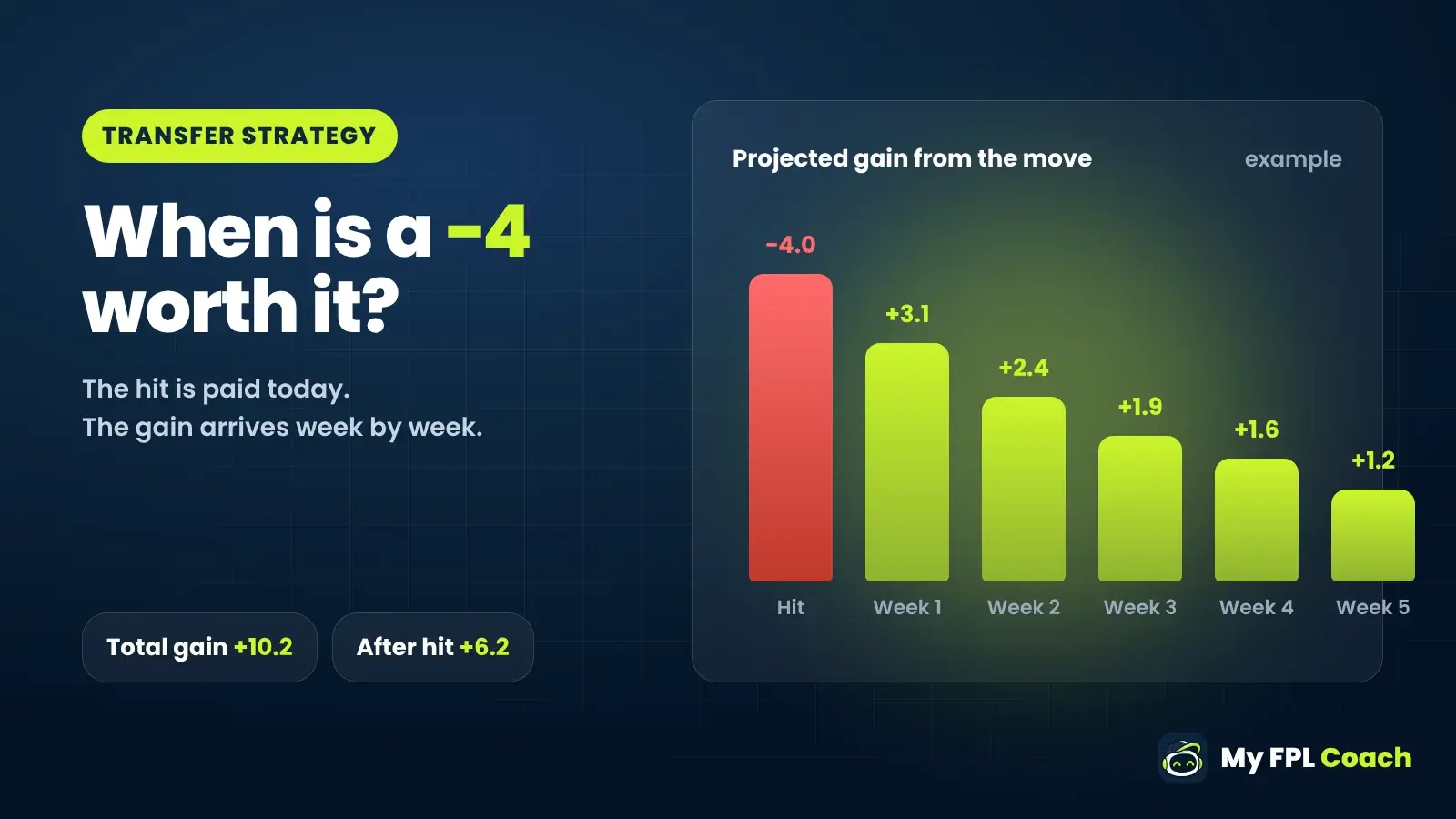
- It would cost a hit. A good fixture alone rarely justifies −4. Our guide to when a hit is worth it explains the maths.
Doubles and blanks
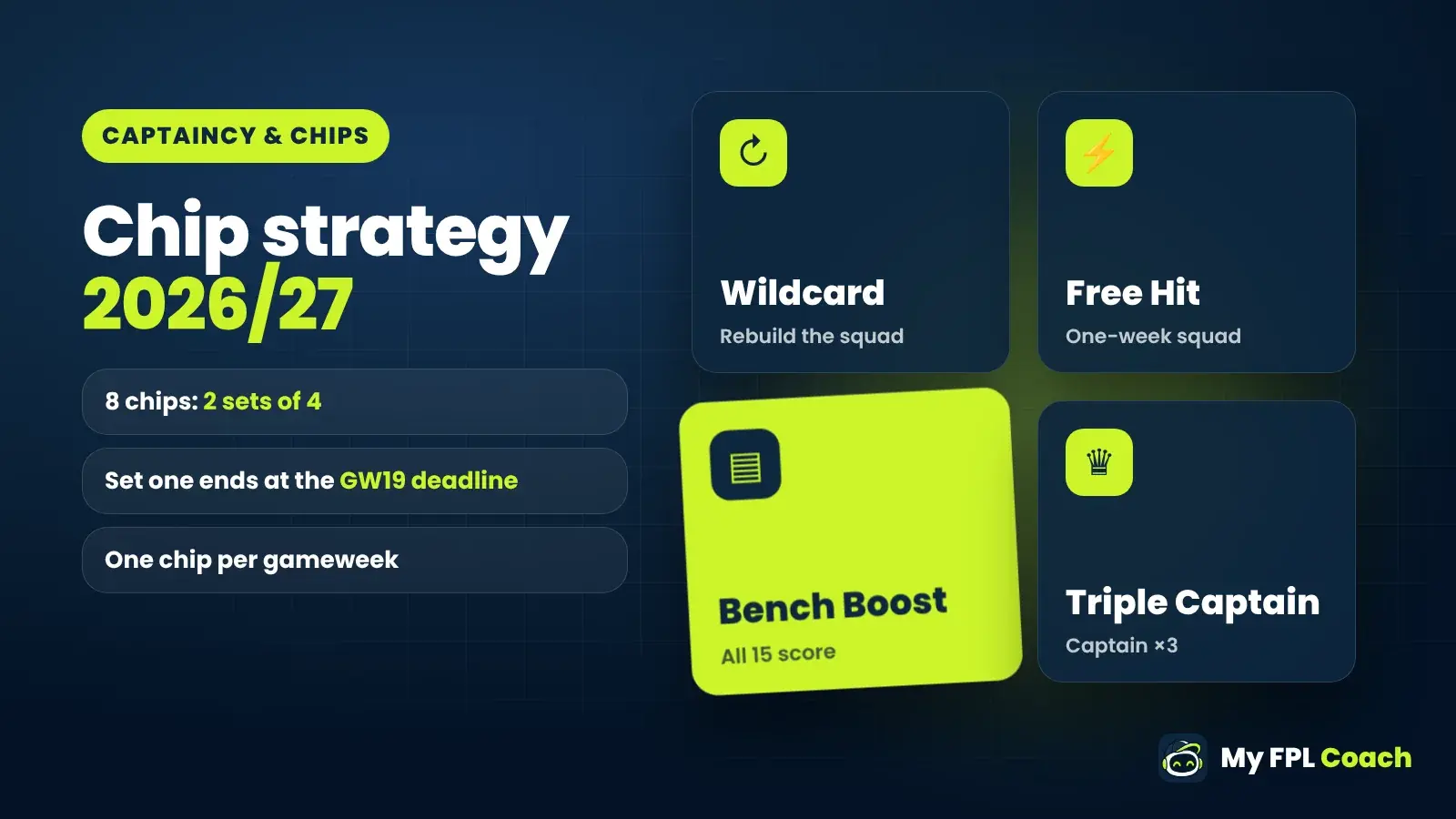
When cup ties or postponements move matches, some teams play twice in a gameweek (a double) and others not at all (a blank). Doubles roughly double a player's expected points for that week, which is why they're the best weeks for Bench Boost and Triple Captain. Blanks are the time for a Free Hit. Our chip strategy guide covers both.
Key takeaways
- Fixture difficulty rates each match, usually from 1 (easiest) to 5 (hardest).
- Compare runs of three to six fixtures, not single games.
- Use the clean-sheet view for defenders and the attacking view for attackers.
- Minutes, penalties and premium quality can outweigh a hard fixture.
See every team's fixtures at once
The My FPL Coach fixture planner shows every club's next gameweeks coloured by difficulty, with separate attacking and clean-sheet views. Pair it with the player comparison tool to check two options side by side before you transfer.